Showing posts with label Endemic bird in Sri Lanka. Show all posts

Tuesday, August 18, 2015

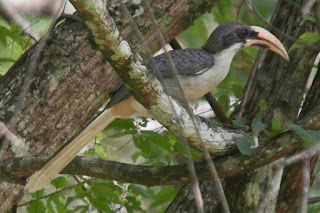
Ceylon Grey Hornbill - Ocyceros gingalensis


Ceylon Grey Hornbill - Ocyceros gingalensis
Ceylon Grey Hornbill Ocyceros gingalensis 

(Sri Lanka Grey Hornbill)
(Endemic bird in Sri Lanka)   

Sinhalese - Kedetta 
Tamil       - Irattai - kondu- kuruvi  


Ceylon Grey Hornbill - Ocyceros gingalensis             The Grey Hornbill is a bird of forest and well wooded areas. It is found both in the wet and dry zones and ascends the hills up to about 1300 metres. In the Dry zone it favours riverine forests though in the Wilpattu National Park it inhabits forest close to the villus as well. It is a grotesque looking bird with an enormous decurved beak, long neck and long tail. Both sexes have similar plumage but the beak of the female is dark with a long cream patch on the upper mandible in contrast to the mostly pale yellow beak of the male. Young are similar to adults but have shorter beaks which are pale yellow, completely devoid of any black colour. Their irides too are grey in contrast to the red irides of adults. The Grey Hornbill generally occupies mid levels of forest and moves about in pairs, though flocks too are met with near fruiting trees. The food consists mostly of fruit but animal matter is also captured especially when young have to be fed. The call is a loud kaa, kaa, kaa. At times a continuous kak,kak,kak, kak,kak call is uttered. 

Ceylon Grey Hornbill - Ocyceros gingalensis


      Hornbills are well known for their remarkable nesting habits. The female chooses a natural cavity in a tree generally about six to ten metres from ground level and incarcerates herself by walling up the entrance with possibly her own droppings and sediment from the nest floor, leaving only a small vertical slit. The vertically flat beak is admirably suited to be used as a mason’s spoon to plaster the opening. The bird moves it up and down, vibrating it sideways at the same time to add and smoothen the walling up material. She moults her flight and tail feathers while inside.
Ceylon Grey Hornbill Ocyceros gingalensis


Sri Lanka Grey Hornbill


Sunday, July 5, 2015

Chestnut-backed Owlet - Glaucidium castanonotum

Chestnut-backed Owlet - Glaucidium castanonotum

(Sri Lanka Chestnut-backed Owlet)
(Endemic bird in Sri Lanka)  

Sinhalese - Bassa
Tamil       - Sinna Andai

This is a very attractive owl, with its dark barred chestnut mantle and wings, black and white radially  barred head, horizontally barred breast which changes to vertical streaking on the abdomen.. The tail is black with seven fine horizontal bands of white. It is the size of the more familiar Scops Owl but has yellow eyes and no ear tufts. It is a rather scarce bird, being confined to the remaining tracts of wet zone forest and their outskirts ascending the wet hills to about 1800 metres. In common with its dry zone counterpart, the Jungle Owlet, it is quite diurnal in its habits, feeding well into the mornings. Due to this reason, though scarce, it can often be

Chestnut-backed Owlet - Glaucidium castanonotum

 observed in suitable habitat. Kitulgala is a particularly good place to observe the species. The bird lives in pairs feeding on insects such as beetles. However when young have to be fed, it catches much larger fare. The call is a far carrying ,kaow,kaow kaow. The threateningsong is a krook krook ascending to a kaow, kaow  and ending in a kao whap, kao whap.
 
Chestnut-backed Owlet - Glaucidium castanonotumSri Lanka Chestnut-backed Owlet
Sri Lanka Chestnut - backed Owlet

Ceylon Lorikeet - Loriculus beryllinus

Stamp of Sri Lanka Hanging ParrotCeylon Lorikeet - Loriculus beryllinus
Sri Lanka Hanging Parrot
(Endemic bird in Sri Lanka) 

Sinhalese - Gira Malichcha
Tamil       - Kanni Killi

       The Ceylon Lorikeet is the smallest member of Sri Lanka’s parrot family. This sparrow sized bird is predominantly green with bright red on the forehead and crown which turns into a golden orange on the nape and hind neck before blending into the green of the mantle. The rump and upper tail coverts are a bright scarlet. The brilliancy of this bird’s plumage is further enhanced by its blue under wing and tail. The male bird’s chin shows a prominent blue which is somewhat lacking in the female, her overall plumage being duller. Young are mostly green all over while very young birds are sparsely plumaged on the head and neck, possibly an adaptation to the  nature of food they are fed on. 

    
Ceylon Lorikeet - Loriculus beryllinus
The Lorikeet is well distributed in the island up to about 1200 metres elevation though it occurs rather sparingly in the dry zone, mostly in the foothills. It prefers well wooded habitat including forest but frequently visits orchards and fruit bearing gardens as well. It feeds on nectar and juicy fruit, in search of which it scrambles along branches with great agility. The Lorikeet is said to have a great affinity for the nectar of the talipot palm. The flight is swift and dashing, the birds often flying quite high. The flight is undulating and the bird utters a three syllabled ‘tchi,tchi, tchi’ call while flying. This call is uttered while foraging too but the bird is so well camouflaged in spite of its bright plumage that it is often difficult to spot while thus engaged. The bird roosts by hanging upside down - bat wise. 

Ceylon Lorikeet - Loriculus beryllinus

    The breeding season is from January to August but mainly during the period from March to May. It lays its eggs in a natural tree hole often at some height from ground level. Henry says the female carries strips of leaves etc to line the nest by pushing them into her voluminous rump feathers. However it is difficult to see how this can be done without these falling off while the bird is flying.   Usually two white eggs, quite circular in shape are laid.

Sri Lanka Hanging Parrot

Related Posts Plugin for WordPress, Blogger...